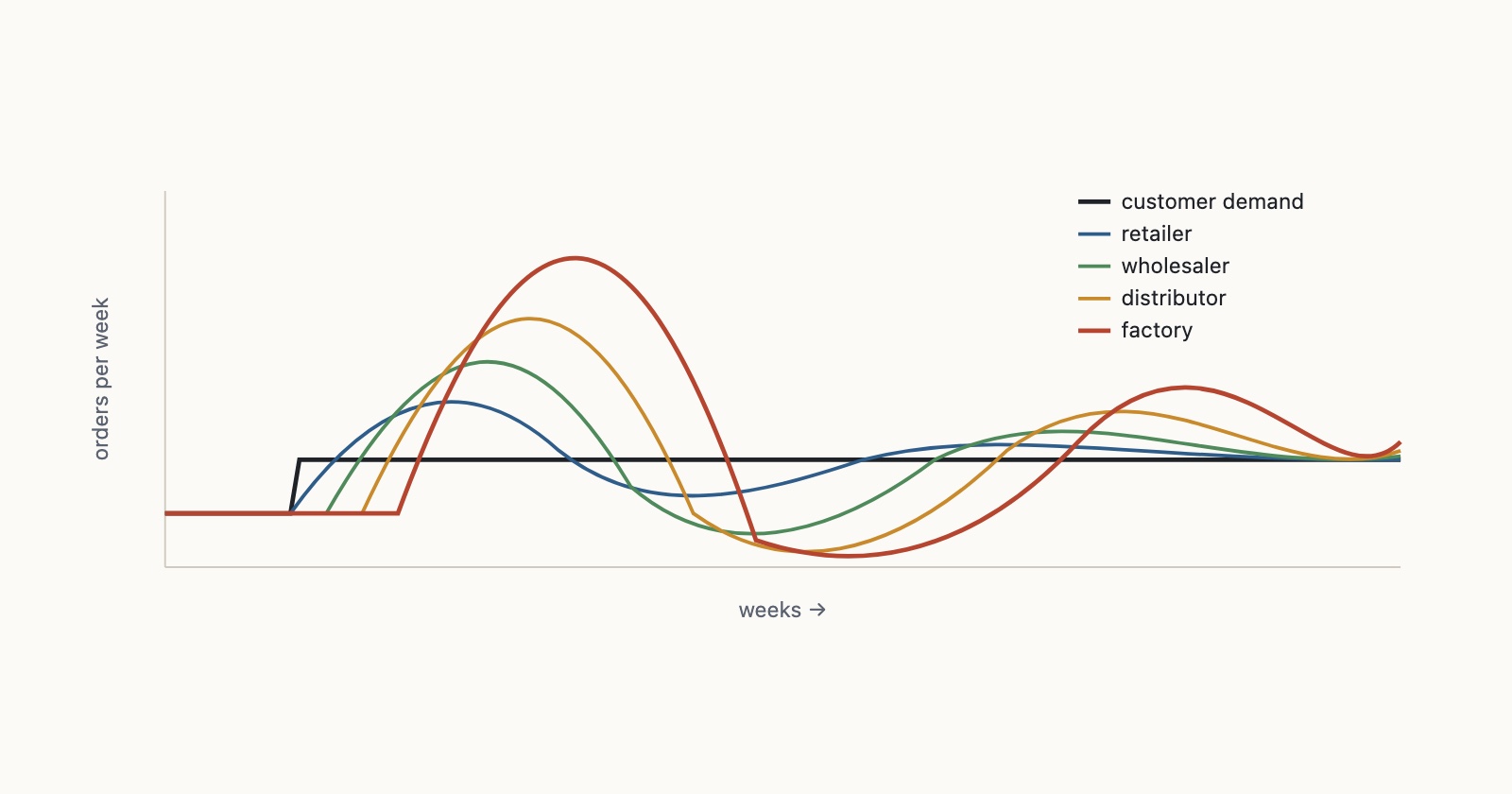
The shape of the bullwhip effect in the beer game. Demand changes once. Everyone upstream of it goes nuts.
Four people sit at a table running a beer supply chain. One is the retailer, one is the wholesaler, one is the distributor, and one is the factory. Each week, each player makes one decision - how much beer to order from the player upstream (the factory decides how much to brew). Orders and shipments take weeks to arrive, and nobody is allowed to talk.
In week five, customer demand goes from four cases a week to eight. Then it stays at eight for the rest of the game.
That’s the only change, and the supply chain still goes haywire. The retailer sees the jump and orders more. Nothing shows up for weeks, the backlog grows, and the retailer orders more again. Each player upstream sees a bigger, noisier signal than the one below. Then the beer arrives in a flood, everyone is buried in inventory, and orders crash to zero. The factory, three steps from the customer, gets the wildest swings of all.
This is the MIT Beer Game. Jay Forrester built its ancestor at MIT in the late 1950s, and John Sterman turned it into a landmark experiment in 1989. His diagnosis is simple:
“Subjects failed to account for control actions which had been initiated but not yet had their effect.”
People stare at the empty shelf and forget about the beer already on the truck.
The AI data center business is playing the same game but with more than four different actors. People and businesses buy AI products. Those products run on models from labs like OpenAI and Anthropic. The labs rent compute from the hyperscalers and from the neoclouds - CoreWeave, Nebius, and a bunch of others whose whole business is renting out GPUs. The clouds buy chips from Nvidia, which buys wafers, memory, and packaging from its suppliers. Each actor sees orders from the actor below it, but none of them see actual end demand. Even if they think they do, they are only guessing at some future state. And, in this game, the delays aren’t measured in weeks. Land, power, permits, and construction take years. Elections and geopolitics change regulatory dynamics, which introduce other delays. This week, the Commerce Department closed a loophole that let Chinese companies rent Nvidia computing power located in other countries. The cost of capital moves with the economy, the risk, and, more importantly, how people perceive future risk.
Nvidia is the factory. Its results this week were spectacular: $115.8 billion in quarterly revenue, up 103%, and $65.3 billion in net income, up 105%, on a 74.8% gross margin. It generated $43.8 billion of free cash flow in the quarter, almost double a year ago. It’s also ordering ahead, with $390 billion in purchase commitments to its own suppliers.
But Nvidia hasn’t only been the factory. It has also been the bank. Nvidia has become known as the “central bank of AI” because it took equity stakes in the labs, backstopped the neoclouds, and ended the quarter with $118 billion in guarantees, $105 billion of which is credit support for the land, power, and buildings at a single Ohio campus that SoftBank Energy is developing and OpenAI will lease for 20 years. In beer game terms, the brewery has been lending the distributor money to order more beer. Some of those bets are already going bad. This quarter, Nvidia took a $1.8 billion impairment on its stakes in private companies.
Then Jensen Huang resigned as Nvidia’s CEO last week in a scandal, and the board says he isn’t coming back.
That landed on a credit market that was already cooling. Reuters reported that banks lining up to fund AI deals a few weeks earlier were now reluctant to do more, and some data center bond deals got shelved. Meanwhile, CoreWeave’s 9.75% bonds due 2031 were yielding 15.66%. Apollo’s Marc Rowan said that if Nvidia’s “guarantor function” gets taken away, “access to capital for a large number of neoclouds is going to disappear.”
On the earnings call, Colette Kress, Nvidia’s interim CEO, explained that the guarantee starts once the builder has raised its equity and debt and is ready to go:
“If all of that begins and unfortunately they are delayed or they have a challenge in terms of building that, our guarantee doesn’t exist anymore.”
Hmmm. The delays are already showing up. Microsoft trimmed its capital spending forecast last month because “some third party capacity deliveries we expected in Q1 were delayed.”
On the same call, Kress said returning capital to shareholders is a “super top priority for us, first and foremost.” Nvidia spent $22 billion buying back its own stock last quarter and $61 billion so far this fiscal year, and it has $227 billion of authorization left after the board added $150 billion in September. It also raised about $25 billion of new debt this year, and the money its customers owe it doubled to $81 billion. With $43.8 billion of free cash flow last quarter, Nvidia can afford this today. But if I were sitting in the factory seat with $518 billion of commitments, $118 billion of guarantees, $32 billion of neocloud backstops, about $110 billion of stock in other companies (many of them my own customers), and customer IOUs piling up, I’d be hoarding cash right now. Instead, the factory is tightening the terms on what it backs for the distributors while buying its own stock. It’s hard for me to read that as anything other than an effort to support a stock that was down 24% for the month going into earnings.
Nvidia ended the quarter with $53.5 billion of cash and short-term investments against $32.4 billion of debt, which leaves about $21 billion of net cash. That’s down from $41 billion at the start of the fiscal year. It also holds $44.2 billion of stock in public companies, which brings its net liquidity to about $65 billion. As long as things are fine, none of this matters. Nvidia is generating over $40 billion of free cash flow a quarter, but it’s spending all of it, and then some, on buybacks, dividends, and stakes in other companies. But if orders slow, customers stretch out paying those $81 billion of IOUs, the neoclouds it backstops start missing payments, and the stocks it holds fall along with its own, $21 billion of net cash against $518 billion of commitments isn’t much. That could get ugly fast.
None of this is new. During the Railway Mania, a third of the track Parliament authorized between 1844 and 1847 was never built, and the boom ended in the Panic of 1847. In 2001, one analyst estimated that only 7% to 10% of the telecom boom’s fiber was lit, and Global Crossing, 360networks, and WorldCom ended up in bankruptcy. Cheap debt funded the shale boom until OPEC refused to cut production in 2014, and oil fell from over $100 a barrel to about $30, taking more than a hundred producers with it. In 2021, everyone hoarded chips, and by 2023 the memory makers were buried in inventory.
In every one of those cycles, the demand was real. The railways that got built got used, the dark fiber eventually got lit and carried the streaming internet, and shale came back, regardless of how gloomy everyone was. The infrastructure survived, but the capital structure that paid for it got wiped out, and different people owned the assets on the other side.
I’m not a cheerleader or a doomsayer about any of this. I think delays turn a small change in demand into big swings, and something comes along that breaks the cycle. In 1847 it was a financial panic. In 2014 it was an OPEC meeting. This month, it might be Huang’s resignation landing on a credit market that was already cooling. Rowan, who is in the business of lending, pointed out that this is how GMAC and Ford Motor Credit came to exist, and I expect some new financing structure will emerge from this one, too.
If you want to feel this in your gut, play the game. MIT runs the official version, transentis has a free one with no account, and the GenAI Beer Game puts LLMs in every seat so you can watch them play on Hugging Face. You need three friends, a rule that nobody talks, and at least 36 rounds. Before the debrief, have everyone draw what they think customer demand looked like. The upstream players usually draw big swings. But, in the classic game (which I played in 1987 during my first week of business school), it only moved once.
Now, imagine if it moved around, a lot, all the time. Yeah, I know the argument “It’s different this time.” In 2000, I was saying that to the older people in the room. Most nodded along, believing my enthusiastic, visionary bullshit. Sound familiar?