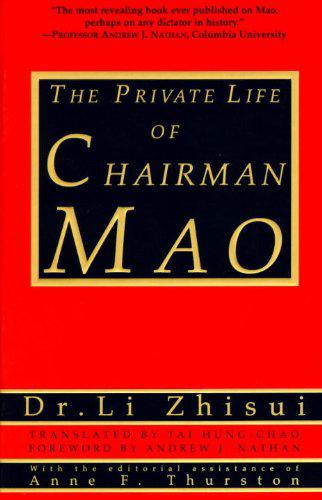
When I finished The Private Life of Chairman Mao, I felt awful.
It’s a long and extraordinarily disheartening book. I knew a little about Mao and some of the things that happened while he ruled China, including the Great Leap Forward and the Cultural Revolution. But, I didn’t really know anything about him.
The author, Dr. Li Zhisui, did. He was born in Beijing in 1919 into a family of physicians. When the Communists took power in 1949, he had a secure life in Sydney, which he left when his older brother urged him to come home. Li became Mao’s personal physician in 1954, and he stayed with Mao until Mao died in 1976.
Li kept copious notes. During the Cultural Revolution, Red Guards searched the houses where he lived and sometimes entered his by mistake. His wife, Lillian, was alarmed, so they burned the notes. After Mao’s death and the arrest of the Gang of Four, she said to him, “What a pity! If we had kept the notes, nothing would likely have happened. We burned them for nothing.” She urged him to write it all down again. In 1988, Lillian was diagnosed with kidney failure and their two sons, who were already living in the US, urged him to bring her there. They arrived in Chicago that August.
She died on January 12, 1989. Before she went into a coma, she urged him again and again to write down what he had seen:
You must do it, for yourself, for me, for our posterity, for our grandson who will soon be born. I am sorry I cannot help you anymore.
In March 1989, he began work on the book. Random House published it in 1994, China banned it, and Li died of a heart attack in suburban Chicago a few months later.
It’s a long book, so it took me a few days to get through it (and it took all my editing discipline not to call it a long march.) It was a detailed journey through China’s history from 1949 to 1976 through the eyes of someone who was with Mao in extremely intimate settings.
Some non-trivial percentage of TV shows and movies have no redeemable characters. You end up rooting for a protagonist, even though their behavior is repulsive, because they are less repulsive than everyone else in the story.
I felt like that throughout this book. I was endlessly looking for someone to root for and never found them.
After Li published the book, he said:
I became a yes man to Mao. I couldn’t say anything that contradicted him. China controlled people. I had no way out.
The internal contradictions and hypocrisy of the leaders throughout the book reminded me of many powerful people, but they were an art form mastered by Mao. The subservience, fawning, and obsequiousness of everyone around Mao were their endless, and often unsuccessful, attempts at self-preservation.
Authoritarians, dictators, and autocrats are so antithetical to my value system. Unfortunately, they are a natural part of the human condition.